
Data processing
An archaeological database
The archaeological database is an interpretive instrument that can be organised in different ways based on the data categories. Finds can be sorted into groups by establishing links between their respective attributes. All sorts of comparisons can be made, based, for example, on dating, type of material, use, special origins, or combinations of these. Within these groups further connections can be established, thereby refining the find categories in response to specific research questions, for example, the grouping of all the knives with brass fittings from Damrak dated between 1500 and 1600.
Processing specific object data
"Altogether a total of 697,235 archaeological finds were retrieved."
Altogether a total of 697,235 archaeological finds were retrieved. This included both complete objects as well as individual sherds. These are documented in 134,282 individual records in a digital relational database (i.e. a database compiled from multiple separate data tables). Multiple finds can be recorded under one record (sherds of a single pot, for instance). A record in a database consists of a number of fields in which the attributes of a find are recorded.
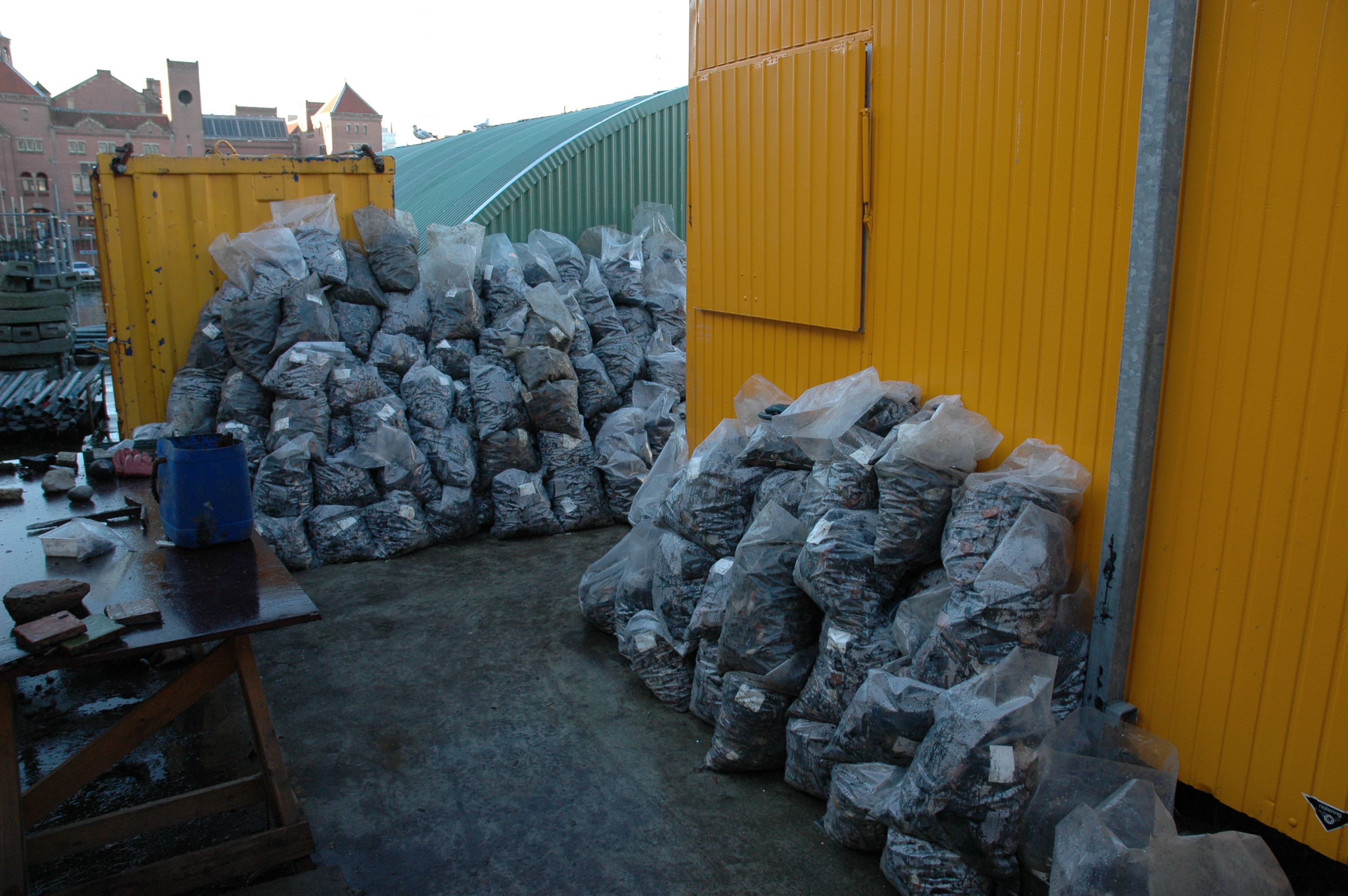
'Harvest' of a week of excavation on the Damrak site
In principle, there are two categories of information: fieldwork data and object data. The former are mainly administrative and might concern, for instance, the date on which the find was made or the location within the excavation. The object data are more varied and primarily describe the perceived attributes of a find, such as its dimensions, material, production method, type of decoration (important for differentiating pottery, for example), the number of fragments or parts within a record or the extent to which an object is complete.
Generic excavational and object data
"Secondly, the registration of every find also involves a set of extrinsic data. In archaeology these concern the find’s functional, chronological and spatial attributes."
Secondly, the registration of every find also involves a set of extrinsic data. In archaeology these concern the find’s functional, chronological and spatial attributes. Functional data records what an object was used for. Many archaeological finds are broken and consist of fragments. When identifying functionality, the aim is to define the function of the complete original object, so that when a find consists of the foot of a vase, the function of the object is given as ‘vase’ and not ‘foot’. The chronological attribute of an object is determined by the period when it was made or used. A dating can be deduced from the object itself because it is representative of a certain type from a certain period, or else from its relation with other finds of known date, which thus provide a relational chronology. The spatial data is recorded under fieldwork data to document the location where the find was embedded. This is why archaeological finds are registered with a stratigraphic indication, recording in which layer, at which depth or exactly where in the horizontal section a find was deposited. For finds from a riverbed such as the Amstel, such data offers something to go on when assessing the spatial context and in turn enables (bulk) finds or certain soil layers to be dated. In a wider context, the spatial attribute of an object has to do with where it was made or, in the case of an import, its place of origin, which in turn can be linked with the type of material and the production technique. This applies in particular to pottery; for example, if the material is porcelain the place of origin could be China.