
Fieldwork at Damrak and Rokin
Fieldwork at Damrak
The technical complexity of the metro construction project meant that standard procedures for archaeological research could not be used. Working methods had to be tailored to the civil engineering programme at the two locations. At Damrak three caissons were sunk to a depth of 25 metres below NAP in 2005-2006 and in 2012. The south caisson (1) was the largest (approximately 60x20 metres) and was sunken over the historical location of the Nieuwe Brug. Joining up with this on the north side were two smaller caissons (2 and 3) which were positioned in the once tidal water of the IJ to link up with the archaeological site on the artificial island on which Central Station was built. After the dismantling of the existing bridge, caisson 1 was constructed on the bed of the Damrak. The caisson was sunk by liquefying the soil beneath the caisson with highpressure water cannons and extracting the slurry through an ejector pipe. The working chamber beneath the caisson was kept under overpressure to keep out the groundwater. The only access was via a decompression chamber. Every day the jetting work was carried out by two teams operating in shifts, each team consisting of a maximum of six workers due to the limited capacity of the decompression chamber. As in diving, the duration of the shift depended on the depth. Each team worked underground for four to six hours and the deeper the caisson sank, the shorter their effective working hours were and the longer they were required to spend in the decompression chamber before returning to normal levels.
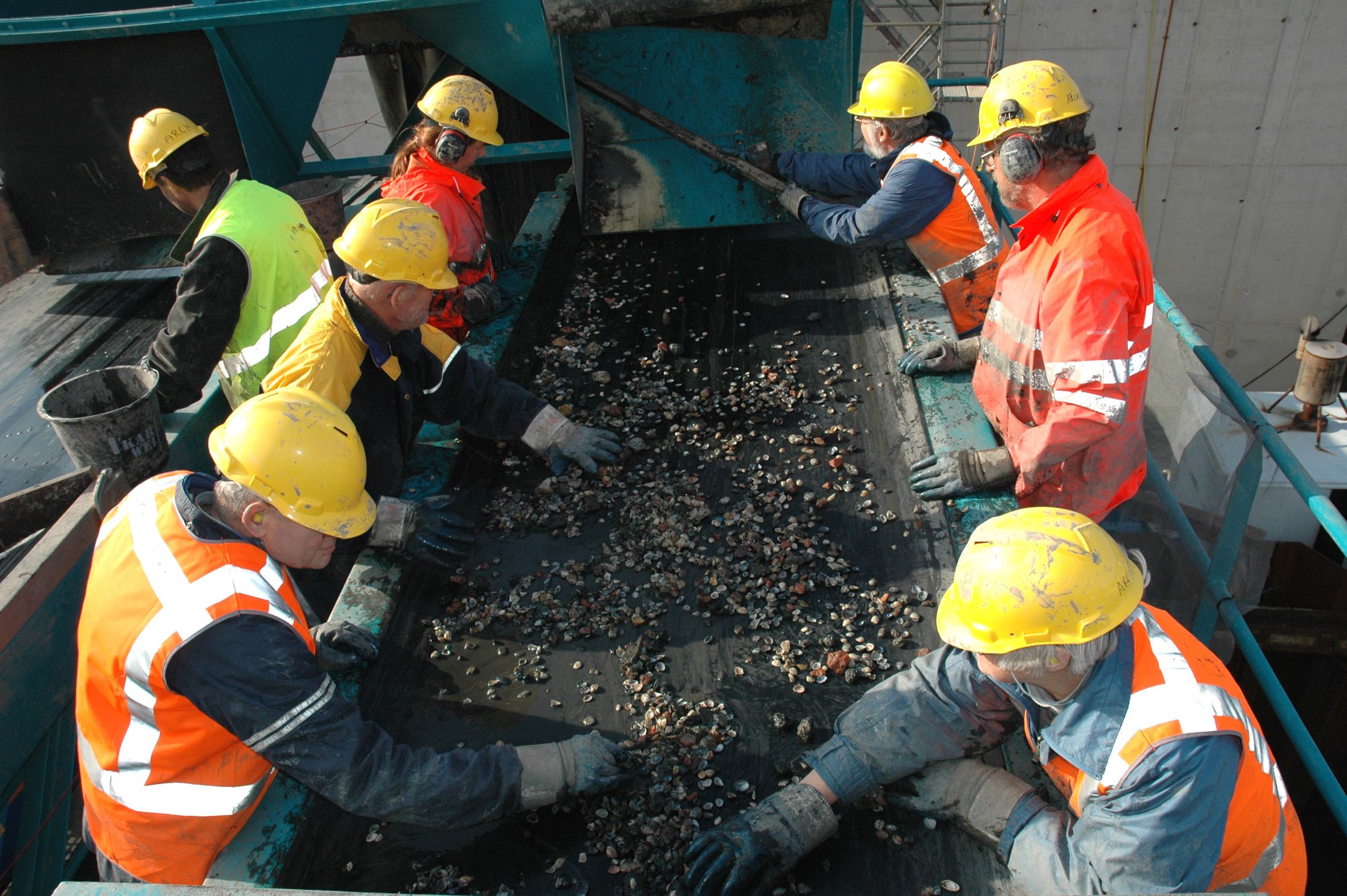
Sieving finds on the Damrak site
"The three-pronged approach of the archaeological programme was devised to fit in with this sinking operation."
The three-pronged approach of the archaeological programme was devised to fit in with this sinking operation. It was standard procedure for each jetting team to be accompanied by a member of the archaeological team to collect individual finds and to identify areas of find concentration and geological phenomena for further research on site. While jetting operations were in progress underground, above ground six to ten archaeologists operated an industrial sieve built into the pump system. The sieve had two decks with different sized mesh (upper deck 4x4 cm, lower deck 1x1 cm) that caught any finds larger than a centimetre from the ejected slurry. Further, a sludge container underneath the sieve collected any even smaller material such as brooches and coins. A third team of archaeologists worked in the evening at the end of sinking operations to document in detail the find and soil context underground. All in all the Damrak fieldwork yielded 465,536 finds (43,045 records in the find database), few of which were retrieved from caissons 2 and 3 in the IJ (4,488 and 3,774, respectively), reflecting the same low retrieval rate as at Stationsplein.
Fieldwork at Rokin
"The archaeological work was split between two locations: on the one hand, in situ at the Rokin site as part of the civil engineering excavation, and on the other, at the soil depot for find research."
At Rokin the archaeological work was carried out in several phases between 2003 and 2011. Rokin was one of the larger metro stations and the construction pit (approximately 280x25 metres) encompassed virtually the whole of the northern end of the River Amstel between Grimburgwal in the south and the Dam in the north, which had been filled in in 1937. Within the deepwalls two entrance halls were constructed and a concrete ‘box’ measuring 190x25 metres for the deep station itself. The floor of the station box was injected at a depth of 30 metres below NAP and a roof constructed so that traffic could continue over Rokin. February 2008 marked the start of the first of five phases in which the station box was excavated to a depth of 27 metres below NAP underneath this roof. Two excavators operating simultaneously side by side removed a 4-5-metre-high layer of soil over the whole length of the pit from south to north, which was then transported to a soil depot.
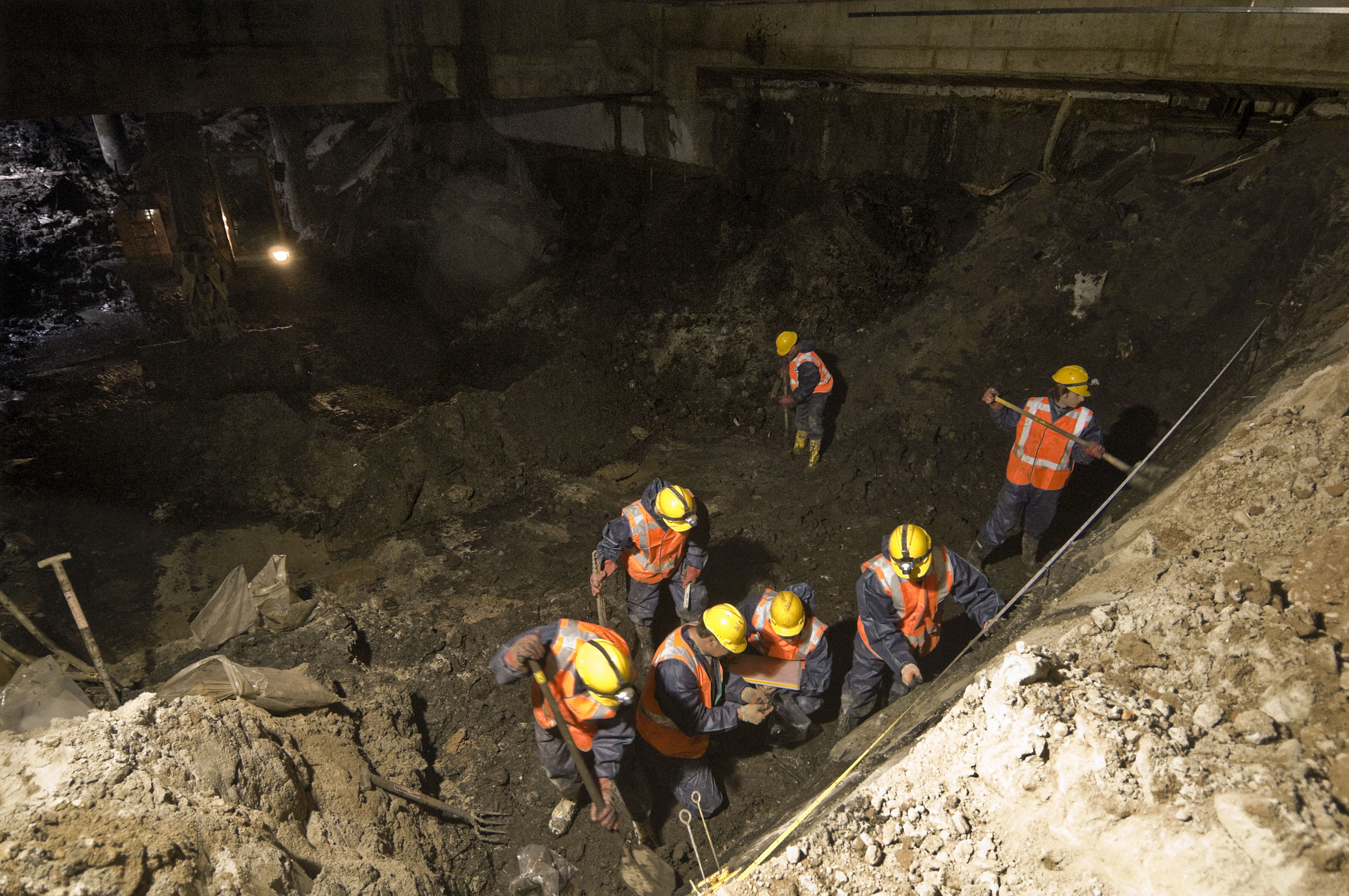
Archaeologists working at the Rokin site (©Wim Ruigrok)
The archaeological work was split between two locations: on the one hand, in situ at the Rokin site as part of the civil engineering excavation, and on the other, at the soil depot for find research. Split into a morning and an afternoon/evening shift of 16 workers, the Rokin team was responsible for examining the filling of the Amstel, which extended to a depth of approximately 12 metres below NAP. The richest find deposits in the river were uncovered during the initial excavation to approximately 6.5 metres below NAP. The stratigraphic position and depth of the finds in the different layers were documented with cross-sections of the Amstel fill, over 100 of which were made. Samples of the sediments were taken for geo-ecological research. The horizontal distribution of the finds was recorded using the east-west division of the excavated area into two 12.5 metre-wide halves, each subdivided into 5-5.5 metre wide sections. By correlating this grid system with the actual parcel layout, the archaeological finds could be linked to historical buildings on both banks of the Rokin along Kalverstraat and Nes. This grid system also made it possible to record the location of the excavated soil. At the soil depot another archaeological team of ten people sifted through the soil for finds, looking especially for small metal finds using metal detectors. The archaeological research at Rokin ultimately yielded 229,943 finds (90,258 records in the find database).
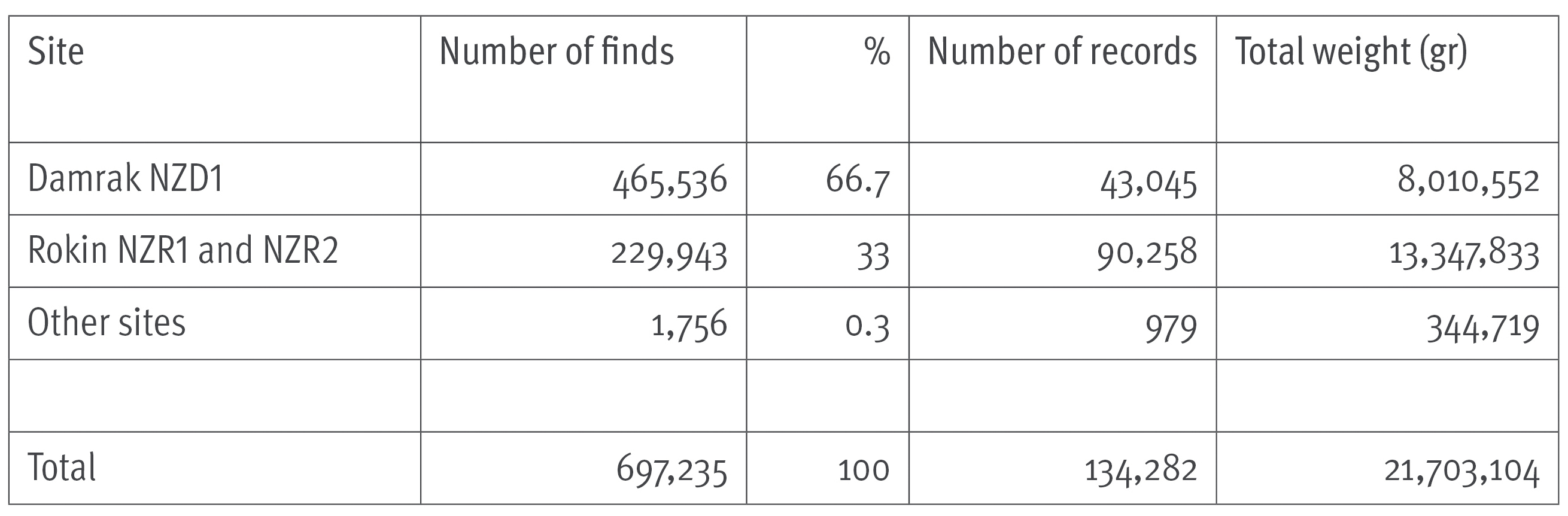
Total number of finds and find numbers