
Streambed archaeology
Before going on to discuss the research on the River Amstel, the question of what makes streambeds archaeologically so special needs addressing. The answer is simple: in rivers, canals and open water material remains can sink to the bottom and large quantities can pile up over time. The everyday practice of dredging illustrates this. Dredgers at work in the canals and ditches in the city never fail to attract an audience because of the variety of objects that comes to the surface, from bicycle wrecks and scrap metal to archaeological items.
"Archaeologists were first alerted to the research potential of streambeds by the nascent discipline of underwater archaeology in the 1960s."
Archaeologists were first alerted to the research potential of streambeds by the nascent discipline of underwater archaeology in the 1960s. The upsurge of finds and discoveries from lakes, rivers, canals and their banks raised general awareness of the scientific value of streambeds as repositories of archaeological finds, while excavations of reclaimed waterways and harbours served to strengthen this idea. In Amsterdam several excavations have demonstrated the archaeological potential of landfilled banks. Elsewhere, recent metro construction projects that transect water zones have likewise yielded a plethora of deposits, such as the excavations of the Byzantine Harbour of Theodosius in Istanbul during the construction of Yenikapi metro station in 2004-2013, or those of the Roman harbour in the Rhine in Cologne while building the Nord-Süd Bahn in 2003-2012. The special archaeological nature of banks and underwater sites has not only been recognised by science, but even in art. Of significance is Mark Dion’s Tate Thames Dig in 1999. Dion used the banks of the River Thames in London as a backdrop for an archaeological installation by collecting finds there at low tide, thereby representing the river as a material source.
Discarded and lost
Quite apart from the physical aspect of archaeological material sinking down in water, underwater depositions differ from deposits on land in the diverse origin and generally mixed nature of the finds. They are primarily associated with shipping activities and vary from items that have fallen overboard to complete shipwrecks and parts of ships. Archaeological remains can also be connected with activities ashore. As such, they can often be linked to objects associated with a building or structure, workshop or installation along the bank.
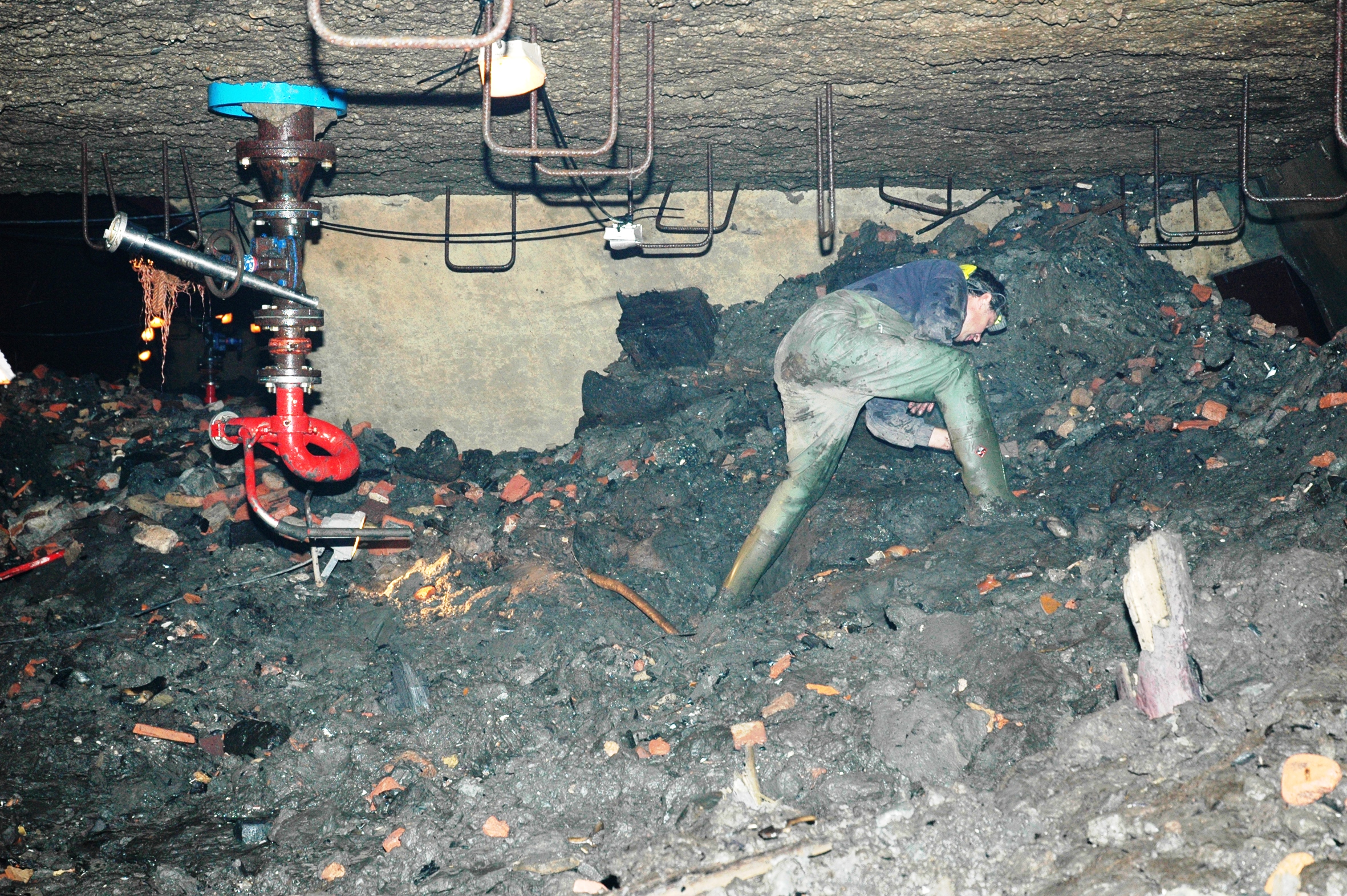
Amstel deposits, full of archaeological finds on the Damrak site
A very different category is the personal belongings that were somehow lost in the water. However, by far the largest group of archaeological finds from streambeds can be attributed to universal human behaviour, namely, to the habit of dumping waste in water. It is an easy way of getting rid of waste, as it immediately disappears out of sight or is carried away by the current. The chance of finding concentrations of material remains is highest in the beds of urban canals due to the high habitation density and the frequency with which inhabitants and workshops discarded their unwanted ‘stuff’ in water. In a water-rich city such as Amsterdam, this was certainly the case. The city’s many historical rulings on the disposal of waste in waterways go back as far as the fifteenth century and clearly attest to the widespread practice of this illegal form of waste disposal and the difficulty in curbing it.
Well preserved below water >"Another factor that makes streambed sites unique is their tendency to remain intact on account of the inaccessibility of the sunken objects."
Another factor that makes streambed sites unique is their tendency to remain intact on account of the inaccessibility of the sunken objects. Once they had fallen in the water it was not easy to get them out. This was, of course, the very point of illegally dumping the waste. Archaeological deposits in streambeds are subject to erosion, however, for instance, if the water level of a river is controlled by dredging or by other hydrological means. In addition to this kind of human intervention, natural conditions and the way the watercourse is used also affect the presence and quantity of underwater archaeological deposits. A longstanding natural streambed that is deeply eroded may hold more finds than a dug canal of recent date. On the other hand, fast-flowing rivers and waterways subject to the rise and fall of the tide or with a rocky bed offer conditions less conducive to the deposition of material remains than a slow river with a soft, muddy bed. Lastly, the nature of the archaeological objects also determines the residue in a watercourse. Light materials will drift on the surface, whereas heavier objects will sink to the bottom at their point of entry in the water.